

Best overall: ThinkFun Gravity Maze — a marble-run logic game with 9 towers, 3 marbles, a game grid and a target piece, so one box covers building and puzzle solving. Best for travel: Educational Insights Kanoodle — 12 pieces and a compact case that doubles as the board, with 228 puzzles in 2D and 3D. Best for a first electronics kit: Snap Circuits Jr. SC-100 — 29 parts that snap onto a plastic grid with no soldering or tools, covering 100+ projects.
The rest of this guide walks through each stem toys pick, who it suits, and what it asks of you.
As an Amazon Associate, we earn from qualifying purchases. This post contains affiliate links – if you buy through them, we may earn a commission at no extra cost to you.
| # | Product | Best for | |
|---|---|---|---|
| 1 | ThinkFun Gravity Maze | Top Pick | Check Price |
| 2 | Educational Insights Kanoodle | Best for Travel | Check Price |
| 3 | Snap Circuits Jr. SC-100 | Also Great | Check Price |
| 4 | Thames & Kosmos Mega Cyborg | Best for Wearable Builds | Check Price |
| 5 | Brain Flakes 500 Piece | Best for Classrooms | Check Price |
| 6 | Smartivity DIY Pinball Machine | — | Check Price |
| 7 | National Geographic Break Open Geodes | Best for Rock Collectors | Check Price |
| 8 | Klutz Lego Gear Bots | Best for LEGO Owners | Check Price |
| 9 | Learning Resources Gears Deluxe Set | Best for Preschoolers | Check Price |
| 10 | Thames & Kosmos Coding Chameleon | — | Check Price |
Best Stem Toys Reviews
1. ThinkFun Gravity Maze

Best for: Kids 8-12 who like logic puzzles
This is a marble run and a puzzle in one box. You get 9 towers, 3 marbles, a game grid and a target piece, and the challenge is to arrange the towers so a marble falls from the top and lands in the target. That’s a different job from free-form building, because the towers have to work with gravity rather than against it.
The listing pitches it for ages 8-12, and it also mentions boys and girls 8-14 and older, so the range stretches further than the headline age. It’s built for solo solving and for working through challenges with friends or family, which means it holds up when two kids want the same toy.
One thing to weigh: the pieces are a fixed set, so once a child has worked through the challenges the box doesn’t grow.
Pros
- 9 towers, 3 marbles, game grid, target piece
- Solves solo or with friends and family
- Aimed at ages 8-12 and up
Cons
- Fixed piece set, no expansions listed
- Puzzle format, not open-ended building
2. Educational Insights Kanoodle

Best for: Kids and teens who need a travel puzzle
Kanoodle is a single-player puzzle you can carry in a pocket. The case holds all 12 colorful pieces and doubles as the game board, so there’s nothing loose to lose in a bag. The listing says over nine million games have sold, which tells you the format has stuck with people.
The 228 challenges run from beginner to expert and split across 2D and 3D configurations. That range is the real point: a beginner can finish a puzzle in a couple of minutes, and the expert 3D ones take far longer, so the same box works for a young child and a teenager.
It’s screen-free by design, which makes it a good fit for car rides and waiting rooms.
Pros
- 228 puzzles, beginner through expert
- Case doubles as board, holds all pieces
- 2D and 3D configurations included
Cons
- Single-player format
- Nothing stays built at the end
3. SNAP CIRCUITS Jr. SC-100 STEM Electronics Kit

Best for: Ages 8+ starting electronics from zero
This kit turns one box into 100+ projects. The 29 parts are numbered and color coded, and they snap onto a plastic grid, so there’s no soldering and no tools involved. The listing says ages 8 to 108 will enjoy it, and the included instruction book walks through each build.
The projects are the draw — you can build a flying saucer that takes off and sounds an alarm, among many others. Because the pieces snap rather than wire, a mistake is easy to undo, which matters a lot when a child is working alone.
Two practical notes from the listing. Batteries are required, so it won’t run straight out of the box. And the seller notes that packaging art may vary, which is worth knowing if the box itself matters to you.
Pros
- 100+ projects from 29 snap-together parts
- No soldering and no tools needed
- Combines with other Snap Circuits kits
Cons
- Batteries required, not included
- Packaging art may vary
4. Thames & Kosmos Mega Cyborg

Best for: Kids who want a build they can wear
This is a wearable mechanical hand you operate with your own fingers. There are no motors and no batteries — the fingers move through hydraulic pistons driven by air pressure and water, so the power source is you. That’s an unusual thing to hold in your hands, and it makes the lesson about hydraulics and pneumatics concrete rather than abstract.
Every finger joint adjusts to different angles, which is what lets the hand grip objects with enough force to lift them. You can build it as a right hand, a left hand, or a claw, and the listing says it adjusts to fit virtually any human hand.
It won the Toy Association’s 2021 STEAM Toy of the Year award.
Pros
- No motors or batteries needed
- Configurations: right, left, claw
- Adjustable finger joints for grip
Cons
- Assembly comes before play
- Water and air pressure setup involved
5. Brain Flakes 500 Piece Set

Best for: Families and classrooms with mixed ages
Five hundred interlocking discs in 12 colors, packed in a jar with a yellow cap. The discs measure 1.3 inches across and the jar stands 8 inches high, so it stores on a shelf without taking over. They click together easily, and the listing pitches the set for ages 3 to 99.
The idea is that you can build large structures from few pieces, and the discs flex, which opens up shapes that rigid blocks can’t make. The listing calls it a quiet-time and screen-free activity, and it names classrooms, makerspaces, daycares and libraries alongside home use.
The included idea booklet covers a flower, a rainbow ball and a tree, with more instructions online. It carries a 90-day manufacturer warranty against defects.
Pros
- 500+ discs in 12 colors
- Booklet plus online instructions
- Non-toxic, BPA and phthalate free
Cons
- Open-ended, no single right answer
- 90-day warranty only
6. Smartivity DIY Pinball Machine I Global Award Winning Game Ages

Best for: Builders 8+ who want a working game
Most STEM kits get built once and then sit on a shelf. This one becomes a real tabletop pinball machine with a spring launcher, flippers and scoring targets, and the listing makes the case that it gets played for months after build day. That’s the difference worth caring about here.
You assemble levers, springs and ramps, and the mechanics are visible while you do it — momentum, energy transfer and mechanical advantage happen in your hands. The listing pitches it for ages 8 to 99, with kids building alongside a parent, teens solo, and adults getting a screen-free project with a payoff.
It’s made from sustainably sourced engineered wood, with rubber bands and marbles included. Every part is in the box, and the seller offers free replacement parts for life. It won the 2022 Innovative Toy of the Year in the Netherlands and was a 2022 TOTY finalist.
Pros
- Becomes a playable pinball machine
- Free replacement parts for life
- Wooden construction, all parts included
Cons
- Assembly is a real project
- Tabletop size, not full-scale
7. National Geographic Break Open Geodes
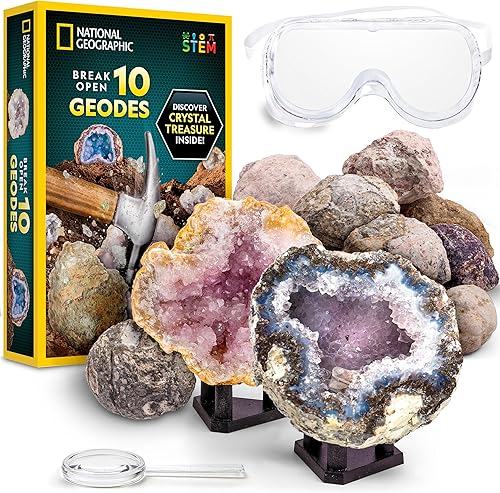
Best for: Kids 8-12 who like discovery
Ten real geodes, hand-selected for variety, and the whole activity is cracking them open to see what formed inside. The listing says they may be as big as a tennis ball or as small as a ping-pong ball, so each one is a genuine unknown until it breaks. That uncertainty is the point — it’s not a kit where you already know the ending.
A full-color learning guide explains how geodes form, which turns a five-minute smash into something a child can actually explain afterward. It’s a natural fit for a kid who likes rocks, collecting, or hands-on science rather than building.
This product was developed by Blue Marble exclusively for Amazon.
Pros
- 10 natural geodes, hand-selected
- Full-color learning guide included
- Real specimens, sizes vary
Cons
- Needs a safe way to crack them
- Messy activity, plan the space
8. Klutz Lego Gear Bots Science/STEM Activity Kit
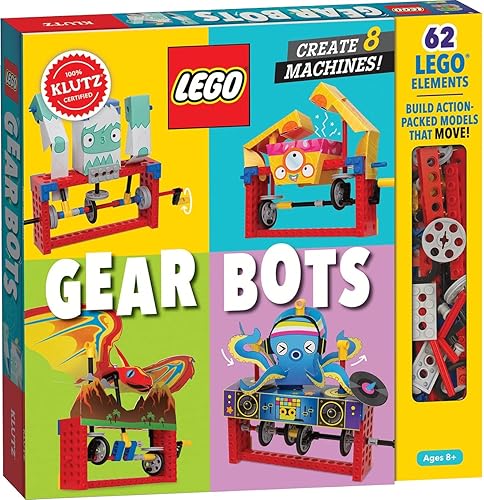
Best for: Kids who already own LEGO bricks
This kit builds 8 physics-driven kinetic creatures using LEGO Technic bricks and papercraft. The listing says every LEGO element you need is included, so you’re not hunting through a bin for a missing piece before you can start.
The 64-page book carries the step-by-step instructions alongside STEM content on axles, cams, cranks, and how engineering shows up in everyday machines. That pairing is what makes it more than a model kit — the mechanism gets explained while the creature gets built.
It’s aimed at ages 8-12. It’s not for a child who wants to keep building past the eight designs in the book, because the instructions stop there and the papercraft parts are specific to those builds.
Pros
- Builds kinetic creatures
- All LEGO elements included
- 64-page book with STEM content
Cons
- A set number of builds, then the book ends
- Papercraft parts are build-specific
9. Learning Resources Official Gears Deluxe Building Set

Best for: Preschoolers exploring how things move
This is a 100-piece set of colorful gears, pillars, axles, bases and a crank handle. Kids snap the pieces together and turn the crank to make their build spin, which is a direct, visible lesson in cause and effect — they do something, and the machine responds.
The listing frames it around motion and early engineering, plus fine motor skills, hand-eye coordination and spatial reasoning. Those are the things a preschooler is actually working on, and the snapping motion is how they practice them.
It’s built for home or classroom use, with STEM challenges, classroom centers, homeschool activities and independent play all named. It ships in the standard retail box.
Pros
- 100 pieces including a crank handle
- Builds spinning, moving creations
- Suits home or classroom use
Cons
- Aimed at the preschool years
- Standard retail packaging only
10. Thames & Kosmos Coding Chameleon

Best for: Kids 8+ learning coding without screens
This is a build-it-yourself robotic reptile that responds to gestures, changes color, and fires and retracts its tongue automatically. The 15-inch model has articulated eyes, torso and leg joints to simulate realistic movement, so it reads as a pet rather than a circuit board.
The coding happens with physical colored action cards. A color sensor, infrared sensor and RGB LEDs let kids program sequences by showing the robot cards — no screens, devices or software. The listing notes assembly is for ages 8+ with adult help, and 12+ for independent play, which is worth reading before you buy it for a younger child.
There are three modes: Coding, Wild and Pet. The 48-page manual covers assembly and the robotics behind it. It won the 2026 Educational Toy of the Year award.
Pros
- Screen-free coding with action cards
- Play modes: Coding, Wild, Pet
- 48-page manual included
Cons
- Adult help needed at age 8
- Assembly required before play
Also Worth Considering
Pocket Microscope 2.0″ IPS Screen is a 1000X handheld digital microscope with a 2.0-inch IPS screen, aimed at kids from age 3-6 up to 6-12. It’s a portable option for a child who wants to look closely at leaves, coins and fabric rather than build something.
National Geographic Magic Chemistry Set packs 10 tricks for kids ages 8-12. It’s a different kind of STEM toy — performance and chemistry rather than construction — and it suits a child who likes showing off what they made.
Learning Resources STEM Explorers Magnet Movers is a magnetism-based set for younger kids. It’s a gentle first step into cause and effect, and it fits a child who isn’t ready for a multi-step build.
How to Choose in Sixty Seconds?
Which difference actually matters when picking a STEM toy?
The one that matters most is whether the toy ends or keeps going. A kit with a fixed number of builds — Klutz Lego Gear Bots with its 8 creatures, or ThinkFun Gravity Maze with its set of towers — gives a clear finish line. Open-ended sets like Brain Flakes 500 Piece and Learning Resources Gears Deluxe Set don’t have one. Match that to your child: some want to finish something, others want to keep making.
What should I skip?
Skip anything that doesn’t tell you what’s in the box. If a listing won’t name the parts count, the age range, or what the toy does, you can’t judge it against what you already own. Also skip a kit that needs tools, batteries or extra pieces the seller doesn’t mention up front — Snap Circuits Jr. SC-100 states plainly that batteries are required, which is exactly the kind of detail worth having before ordering.
What should I confirm before ordering?
Confirm two things: the age range, and whether an adult needs to be involved. Thames & Kosmos Coding Chameleon says ages 8+ with adult help and 12+ for independent play — that’s a different purchase depending on your child. Thames & Kosmos Mega Cyborg and Smartivity DIY Pinball Machine both put assembly before play, so check that the build itself is something your kid will enjoy. For toys with small parts, CPSC’s toy safety guidance is a useful check on age labeling.
FAQs on Best Stem Toys
Does a STEM toy need batteries to be worth it?
No. Several picks run on nothing but the child: Thames & Kosmos Mega Cyborg uses air pressure and water instead of motors, and ThinkFun Gravity Maze runs on gravity alone. Battery-free toys get picked up more often, since there’s no wait and nothing to recharge.
What goes wrong first with these toys?
Lost pieces, most often. Kanoodle and Brain Flakes 500 Piece both solve that with their own containers. The second common issue is a child outgrowing the format — Klutz Lego Gear Bots stops at 8 builds, and ThinkFun Gravity Maze has a fixed set of towers. Thames & Kosmos Mega Cyborg sidesteps wear with no motors to burn out, and Smartivity DIY Pinball Machine offers free replacement parts for life.
Is the simplest toy on this list enough?
Often, yes. National Geographic Break Open Geodes is ten rocks and a guide, and it delivers a full afternoon of discovery. Brain Flakes 500 Piece is a jar of discs with no instructions beyond a booklet, and it works for ages 3 to 99. If your child is new to STEM toys, starting simple tells you what they actually enjoy before you commit to a bigger kit with more parts.
Closing
ThinkFun Gravity Maze is the pick if you want one box that covers building and puzzle solving, and Educational Insights Kanoodle is the one to grab if the toy needs to travel. Both hold up because the challenge changes as the child gets better at it. Before you order, read the age range on the listing and check whether the kit needs batteries, tools or an adult in the room — those three details decide whether a STEM toy gets used or shelved.
1 thought on “10 Best STEM Toys for Kids Who Love to Build and Learn”